
SEO is a significant factor in how you rank in search engines, also known as SERPs (search engine results pages). But how exactly do you maximise the benefits of SEO?
You want the best SEO results for your business, but figuring out how to achieve them can be confusing. There’s a lot of conflicting information available. It’s challenging for a small business owner to cut through the noise and identify the key factors to focus on. I know I’ve been there when I ran my ecom brands back in 2005, or so I think it was.
But that’s where I can help you. I’m going to take you through SEO and the key factors you can apply that will help you to get the best SEO results for your small business.
What is SEO, aka search engine optimisation?
Let’s first start with what SEO is for anyone new to digital marketing and their online journey.
SEO enhances your website to improve its visibility in search engine results pages (SERPs). A successful SEO strategy involves using the right keywords and optimising the various elements of your website, such as content (your words and images on the page) and technical aspects, to make it easier for Google and other search engines to understand and rank your site.
If you’d like a more in-depth explanation and run-through of SEO. Head to our great article: What is SEO?.
Here are some ways to get your small business started on its SEO journey.
Use keywords effectively
It all starts with your keywords. Your keywords will help search engines understand the content of your page.
Ideally, you should use your most important keyword for each page in the following, but remember, there are exceptions to the rule sometimes (see below):
- Title
- Page URL
- Meta description
- In the first paragraph, or approximately 100 words of the page
- Image file name
- Image alt tag
When it comes to exceptions to the rule that I mentioned above, you want to utilise your keywords throughout your web copy, but first and foremost, ensure it reads well and makes sense for your website visitors and ticks all the boxes for Google second.
Improve your website speed
Your website should ideally load in 1-3 seconds or less.
To help make this happen, ensure you’re using high-quality hosting, as web hosting is an industry where you tend to get what you pay for in terms of quality service.
Set up caching on your website and optimise the delivery of your content so that everything loads as quickly as possible for your users.
Optimised images are an easy way to improve your website speed if you have uploaded bulky, high-res images.
There are exceptions to the rule, and sometimes I opt for a higher image quality, as I want my website visitors’ first impression of my services to be a positive one. However, you’ll have to weigh that one up: quality images vs. fast web speed.
Create great content
Instead of creating numerous small content pieces, focus on fewer, high-quality pieces that can capture the attention of your ideal customer.
Longer-form blog posts are ideal for this, with posts being at least 1,000 words in length.
Before you write another blog post, do you have a blog post that you can improve on and add to?
Also, don’t just write for the sake of writing; do some research into what your website visitors want to read about. Often, when I’m putting together Content Plans for clients. The content topics they give me as a starting point aren’t actually what your ideal customer or client is looking for.
Update existing content
For any pages or blog posts that are older than 12 months, consider updating the content to ensure it remains relevant today. Search engines love updated content, so keep adding to pages over time wherever possible.
Blog posts are especially important for service based businesses that aren’t necessarily adding new services all the time.
E-commerce businesses that continually add new products and categories can easily meet Google’s criteria for fresh, new content. However, creating blog posts is an excellent way for a service-based business to address that aspect.
Review your analytics
Regularly reviewing your analytics will help you identify which content is performing well on your website, as well as areas that could be improved.
If you find pages that aren’t getting many visits or that visitors are leaving quickly, analyse them and look for things you can improve.
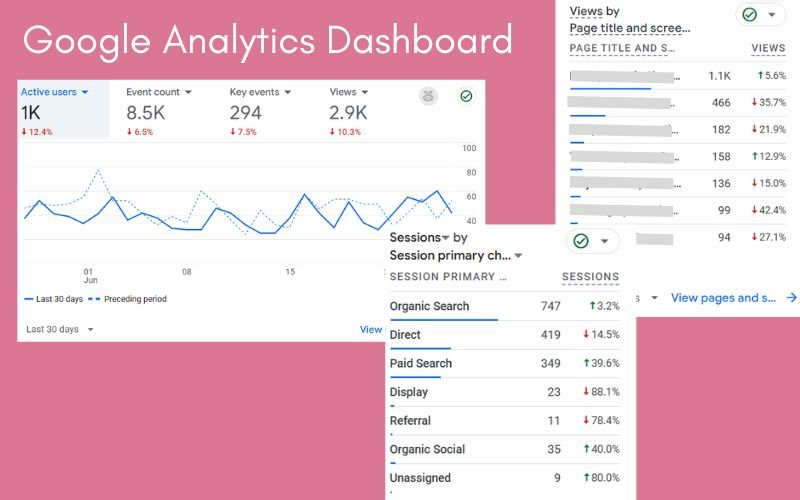
I recommend and use Google Analytics and Google Search Console. They’re both free Google tools and offer slightly different things, so I always recommend setting both up.
If you don’t have them and aren’t comfortable setting them up, let me know. It’s not a big job at all.
Encourage users to stay
The most effective way to encourage people to stay on your website is to deliver engaging and valuable content.
Make sure your content is easy to read and break up large sections of text with:
- Headings
- Sub-headings
- Images
- Video
We are chronic skim readers, so the easier your content is to consume, the longer people stay on your website.
AI and SEO
AI can provide you with ideas and suggestions to enhance your SEO. For example, AI can:
- Suggest possible keywords
- Ideas for blog posts
- Content for blog posts
Don’t just rely on AI for content creation, but instead use it as a handy guide or someone to bounce ideas off.
Ensure you check the information AI produces in case it gets it wrong. That’s really important when you’re trying to position yourself as an authority in your industry with your website and blog content. You can read more about my thoughts on AI and SEO in my great article.
SEO vs SEM
Search engine optimisation and SEM (search engine marketing) are both essential strategies for increasing visibility and traffic to small business websites, but they operate in different ways.
SEO
As I said earlier in this article, it is the practice of optimising your website to rank higher in organic (non-paid) search engine results. It involves enhancing various elements such as site structure, content quality, keyword usage, and backlinks to make the site more appealing to search engines. The goal of SEO is to increase the quantity and quality of traffic to your site over time.
Search engine marketing
On the other hand, SEM typically refers to paid search advertising. SEM is where you pay for ads to appear in search engine results, often using platforms like Google Ads. SEM can provide immediate visibility and traffic, placing your site at the top of search results for specific keywords.
So, the difference lies between organic growth vs paid ads and strategies. Both can be effective depending on your goals and budget.
How to get your website to the top of Google
Do everything I’ve suggested in this article with your focus on high-quality, informative, and relevant content that will appeal to your target audience.
Conduct thorough keyword research and incorporate your findings naturally, including long-tail keywords that are specific to your niche.
Also, ensure your website is:
Optimised for mobile
As a significant number of searches are done on mobile devices. So, use a responsive design to ensure compatibility across various screen sizes.
Build quality backlinks
Develop a strategy to acquire backlinks from reputable websites in your industry.
- Guest blogging
- Collaborations
- Creating shareable
Are all fabulous ways that can help.
Utilise social media
Promote your content through social media channels to drive more traffic to your website. Engagement on socials can lead to shares and backlinks.
Be aware, though, that some social media channels, Facebook in particular, don’t like links in your caption as it encourages people to leave their platform, so the reach of posts where you share links in the original caption can be less than usual. So, think about creative ways you can still encourage people to consume your other content:
- Comment below if you’d like the link
- DM me for more details or the link
Optimise for local search
If you have a local business, optimise your site for local SEO by claiming your Google Business Profile listing and using local keywords.
Post to your Google Business Profile regularly as you would on social media. One post per week is good. But optimise the caption for local search words.
And encourage customers and clients to leave a review on your Google Business Profile and respond to them as well.
Use Google Analytics and Google Search Console
Track your small business website’s performance and understand how users interact with your site.
Then use these insights to refine your SEO strategy.
Heatmaps can also be a great way to see how customers or clients interact with your website. It’s a much more visual way to see how people move around your site and what they click on, etc.
Stay up to date with SEO trends
Search engine algorithms are constantly changing, so stay informed about the latest trends and updates in SEO to adjust your strategies accordingly. SEO is definitely not a set-and-forget option.
Invest in expert help
To receive the best assistance with your SEO, consider consulting with me, your friendly and reliable SEO expert.
I’ll be able to work directly on your website, using my 20 years of experience in SEO and the online space to help you bring more visitors to your small business website, which will, in turn, generate more leads and sales.


0 Comments